Tuesday, 31 December 2013

About Garden Slugs


There's only one thing to do to get rid of the slugs -- Stand Up and Be Counted!

See what started it all in "Fighting back and Making a Difference". As Nellie2 explains here:
Basically, what is happening is that if you are unlucky enough to visit a malicious site then your browser will install some of the crud from this site and your dial-up networking settings will be changed to get you to dial a for-pay service. (And yes, a lot of people still have dial up modems installed). More info here at Spyware Confidential
This is defintely a topic to follow. If you run in to those slugs, please go to Malware Complaints and state your case.

Building Permit Required


The rumor mill has it that some time in the future Microsoft will require a *building permit* for their Windows Genuine Advantage (WGA) tool or your garden will turn to dust. In "Ed Bott's Microsoft Reports" at Is Microsoft about to release a Windows "kill switch"? the following quote was included from Dave Farber’s Interesting People list:
". . . in the fall, having the latest WGA will become mandatory and if its not installed, Windows will give a 30 day warning and when the 30 days is up and WGA isn't installed, Windows will stop working . . ."
Ed Bott contacted Microsoft and reported the following response from a Microsoft spokesperson:
"As we have mentioned previously, as the WGA Notifications program expands in the future, customers may be required to participate. [emphasis added] Microsoft is gathering feedback in select markets to learn how it can best meet its customers' needs and will keep customers informed of any changes to the program."
I agree that software piracy is a serious problem and has been for a long time. However, someone needs to explain to me how my licensed copy of Microsoft software, which has already been confirmed as valid more than once, requires periodic re-confirmation of that validity. I do not want a telephone booth in my garden.

Worms Detected!


Yesterday I reported about "Worms in the Garden." It is with relief that I learned from MVP Donna that Trend Micro is now detecting this worm. A big thumbs-up to those who obtain samples of the files and submitted them to the vendors.
See Trend Micro:

BKDR_IRCBOT.DB Behavior Diagram

Certificate - Microsoft MVP Site


In "Garden Certificate Basics", I provided background information about Website Certificates, including an example of a highly questionable website using a false certificate. This was brought about by a question a visitor to this site raised when presented with a Certificate for mvp.support.microsoft.com, which is linked in my first blog entry, "About Me".

In order to demonstrate how to examine a safe certificate, I deleted the certificate from my computer for mvp.support.microsoft.com. After closing the browser and reopening the link for this blog site, I was immediately presented with the certificate notice below. This gave me the option to accept the certificate permanently, accept the certificate just for the session, or, finally, to not only not allow the certificate but also not connect to the site.
Note that the pre-selected option is to temporarilly accept the certificate for the session:


I had one additional choice. That was to Examine the Certificate. That is the option I selected which opened the Certificate Viewer. Note the information presented: "Could not verify this certificate because the issuer is unknown." That does not mean that the site is not safe. The statement merely reflects that mvp.support.microsoft.com (in this instance) is not a recognized authority. Additionally note, however, the Common Name (CN) on the Certificate: mvp.support.microsoft.com.


Observe on the detail screen that the Certificate Hierarchy is indicated as mvp.support.microsoft.com. That matches the site URL linked in the previously mentioned blog entry, "About Me".
With those details; that is, the Common Name (from the General tab) and the Certificate Heirarchy both matching the URL for the MVP site, you know that it is safe to close the Certificate Viewer, and accept the certificate.

Patch Update -- MS 06-040


If you haven't installed the Microsoft Updates released this past "Patch Tuesday ", its time to take action! Even the Department of Homeland Security is getting into the act:
"The Department of Homeland Security (DHS) is recommending that Windows Operating Systems users apply Microsoft security patch MS06-040 as quickly as possible. This security patch is designed to protect against a vulnerability that, if exploited, could enable an attacker to remotely take control of an affected system and install programs, view, change, or delete data, and create new accounts with full user rights."
MS06-040 and the other updates released on "Patch Tuesday" can be downloaded directly from TechNet. This update should be installed on the following affected systems:

-- Microsoft Windows 2000 Service Pack 4
-- Microsoft Windows XP Service Pack 1 and Microsoft Windows XP Service Pack 2
-- Microsoft Windows XP Professional x64 Edition
-- Microsoft Windows Server 2003 & Microsoft Windows Server 2003 Service Pack 1
-- Microsoft Windows Server 2003 for Itanium-based Systems and Microsoft Windows Server 2003 with SP1 for Itanium-based Systems
-- Microsoft Windows Server 2003 x64 Edition
Note: Windows 98 and ME are not included in that list. Remember, those operating systems reached the end of the life support cycle on July 11, 2006. For all systems, see Microsoft Support Lifecycle by Product.
Microsoft has a toll-free number available to call in the event you are having problems with this or any other Microsoft Update. The service is free and is for all virus and security-related support. It is available 24 hours a day for the U.S. and Canada.
Call: 1-866-PCSAFETY (1-866-727-2338)
For support outside the United States and Canada, please contact your Microsoft Help and Support worldwide. Go to Microsoft Security Home and choose your region from the box in the upper right corner.

MS06-040 Pops Up Again - "Microsoft Security Advisory 922437"


The importance of installing MS06-40 cannot be stressed strongly enough. If you are having problems with the update, Microsoft has a toll-free number available. It is available 24 hours a day for the U.S. and Canada. Call: 1-866-PCSAFETY (1-866-727-2338)

For support outside the United States and Canada, please contact your Microsoft Help and Support worldwide. Go to
Microsoft Security Home and choose your region from the box in the upper right corner.


There are steps you can take in the meantime if unable to get the update. First and foremost, have a firewall on your PC. Next, block TCP ports 139 and 445, inbound and outbound. (Microsoft has additional information on TCP/IP filtering here.) To test your firewall, go to GRC.com and run Shields UP!
For complete information, see Microsoft
Security Advisory 922437, "Exploit Code Published Affecting the Server Service", Published 11August2006:
Microsoft is aware that detailed exploit code has been published on the Internet for the vulnerability that is addressed by Microsoft security bulletin MS06-040. Microsoft has verified the published exploit code to work on Windows 2000 and Windows XP Service Pack 1 only; this code does not affect Windows XP Service Pack 2, Windows Server 2003, or Windows Server 2003 Service Pack 1. At this time our investigation of this exploit code has verified that it does not affect customers who have installed the update detailed in MS06-040.{Snip}

Customers who believe they have been attacked should contact their local FBI office or report their situation to www.ic3.gov. Customers outside the U.S. should contact the national law enforcement agency in their country

Mitigating Factors:
Customers who have installed the MS06-040 security update are not affected by this vulnerability.
While installation of the update is the recommended action, customers who have applied the mitigations as identified in MS06-040 will have minimized their exposure and potential exploitability against an attack.

When Do You Update?


A regularly maintained garden provides a brilliant show year round. Gardeners have charts available for when to fertilize, how short the grass should be clipped, how to trim the shrubs, which plants do best in the the sun and what selections are better for a shade garden.

To maintain your computer, you need to keep the security software updated.
How do you know when it is time to update the security software programs on your computer? Is this a daily, weekly or rather an . . . oops. . . project? Unlike gardens, there are no charts, graphs or the like for this task. I have a work-around though.
I happen to frequent many of the online security forums where updates are posted on the popular security software programs. Helping at the security forums happens to be my hobby, but most likely is not something everyone else does regularly. There is a solution for avoiding the "oops" problem for those who do not frequent the forums on a regular basis. First, register at one of the sites that maintains a security update forum. (Rest assured, no personal information is needed -- just an email address and a "user name".) Next, locate the software update forum. Scroll down the page to the update information for the software on your computer and "subscribe" to the thread. Repeat for each software you need to remember to update.

Subscribing is easy.
Some time ago, I prepared instructions for subscribing to the updates at LandzDown Forum, a computer help site using SMF software. Rather than repeat the instructions here, see the illustrated instructions at "Stay Current -- Subscribe to the Update Topics for your system software!"
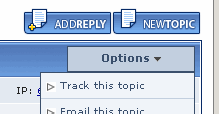
IPB is a popular forum software. Subscribing with IPB is about the same as with SMF. Click the "Options" button at the top of the thread for each software you want to receive an update notification for and then and select "Track this topic":

You will be redirected to your profile where you can elect your preferred notification method as illustrated here:
Please choose your notification method.
Forum subscriptions will notify when new topics have been made and topic subscriptions notify when a reply has been made.
No Email Notification
This option will not send out any email notification but will retain the topic or forum in your subscriptions panel.
Delayed Emailed Notification
This option will send out a notification if a new topic or reply has been made and you're not active on the board.
Immediate Email Notification
This option will send out a notification immediately after a new topic or reply has been made regardless of your activity.
Daily Email Digest
This option will send out a daily digest showing all new replies or topics for that day
Weekly Email Digest
This option will send out a weekly digest showing all new replies or topics for that week


Subscribing to other forum software is similar to IPB. With phpBB, look for the link at the bottom of the page to "Watch this topic for replies". To unsubscribe, return to the thread and click "Stop watching this topic".
When an update is posted to the topics you are subscribed to, you will receive an email notification. Following the link in the email to read about the updated information.
Another option, other than manually checking each software for updates, is to review the listings at Calendar of Updates. You can select multiple views, including A to Z View, Month View, or Week View. While you're at "COU", check out the site. It is jam-packed with information!

Staying up to date is easy if you take a few minutes to organze. So, no more "oops"! If you are not a member of a security forum, try an ASAP Member site.

Java

Ah, that first cup of coffee in the morning always seems to taste better while sitting outside in the garden. Except I'm not here to talk about the joys of early morning outside. No, this is neither about that morning wake-up cup of java nor the island located south of Borneo in Indonesia. Remember, this is the "Security" Garden. This topic is about the Java "language".

What is special about Java? Simply stated, Java is a language that allows coded web pages to be viewed on the browser. Do you need Java on your computer? No. It just makes the internet experience more fun. As indicated at Java.com:
Java technology is everywhere

From the Mars Rover all the way to your mobile phone, Java technology is changing the world around us, and beyond. It's used in practically every major industry, from education, government, and space exploration to transportation, finance, telecommunications, and more. It enables applications and products of all kinds to do something unique and incredible: Communicate. Integrate. Animate. Interact. Protect.
The problem, as discussed in a very long topic at Broad Band Reports entitled, "Winfixer/ Vundo / Virtumonde Victims : Please Read", started by Microsoft MVP CalamityJane, is that computers with older versions of Sun Java are vulnerable to the "Vundo" infection. It doesn't matter if the latest update was applied. If the older versions are still resident on the machine, the vulnerability is definitely there. So, what do we recommend? Definitely to uninstall all prior versions of Java. The instructions that seem to work best follow. The current version is Java Runtime Environment (JRE) 5.0, Update 8.

Sun Java Installation/Update Instructions

The following procedure is strongly encouraged to remove older version Java components:
  1. Close any open programs you may have running, especially your web browser
  2. Click Start > Control Panel (Depending on your OS or configuration, you may have to click Start > Settings > Control Panel)
  3. Open Add or Remove Programs (If you have Windows 98 or Windows 2000, open Add/Remove Programs)
  4. Click once on any item listing J2SE, Java Runtime Environment or Java WebStart in the name. (Not every version of Java will begin with "Java" so be sure to read each entry in the list)
    IPB Image
  5. Click the Remove or Change/Remove button
  6. Follow steps 4 and 5 as many times as necessary to remove all versions of Java
  7. Search 'Programs' and 'Application Data' and remove old version files manually.
    1. C:\Program Files\
    2. C:\Documents and Settings\USERNAME\Application Data\
  8. Restart your PC once all Java components have been removed
  9. Proceed with reinstalling Java by going to http://java.sun.com/javase/downloads/index.jsp
  10. Click the "Download" button to the right of
    Java Runtime Environment (JRE) 5.0 Update 8
    The J2SE Runtime Environment (JRE) allows end-users to run Java applications.
    Installation Instructions | ReadMe | ReleaseNotes | Sun License | Third Party Licenses
  11. Accept the agreement at the page that opens:
    Required: You must accept the license agreement to download the product.
  12. Click: Accept License Agreement
  13. The page will refresh to Windows Platform - J2SE™ Runtime Environment 5.0 Update 8
  14. It is recommended that you select:
    Windows Offline Installation, Multi-language jre-1_5_0_08-windows-i586-p.exe 15.74 MB
  15. After installing the downloaded file, restart your system again to finalize the process.

Java Update


Those of us in the security community will be enjoying our "Java" just a bit more these days. It isn't that the vulnerability issue with prior versions of Java no longer exists. Rather, it is that Sun Java has finally acknowledged the problem.

For a bit if history, Microsoft MVP CalamityJane detailed at Broadband Reports that fellow Microsoft MVP, Steve Welscher wrote to Sun about this issue in February, 2005:
Fellow MS MVP Steve Wechsler (aka MowGreen) wrote to Sun Microsystems (makers of Sun Java) to express the concerns raised in the Security Community that autoupdaters of Sun Java do not uninstall previous (vulnerable) versions of the program. He asked for clarification that if a User utilizes the automatic update mechanism of the JRE the previous vulnerable version is left on the system, and that those previous vulnerable versions can still be called by malware. The folks at Sun Microsystems wrote back confirming this is true and they would be investigating updating the java.com pages and the auto update uninstallation issue.
I wonder how many thousands of computer have been needlessly infected merely because there was no warning to uninstall prior versions of this software for 18 months after Sun Microsystems acknowledged the problem. Coincidentally, after seeing that there was still a lot of confusion in both updating and knowing what Java components to remove, I provided instructions just the other day in Java.

Below is a partial copy of Sun Alert ID 102557. Please keep in mind that this is merely an acknowledgement of the problem. It is still necessary to follow the instructions to remove prior versions of Java to avoid the Winfixer/Vundo/Virtumundo infection.


Java Plug-in and Java Web Start May Allow Applets and Applications to Run With Unpatched JRE
1. Impact

The Java Plug-in and Java Web Start both allow applets and applications to specify the version of the Java Runtime Environment (JRE) to run with. However, the versions of Java Web Start and the Java Plug-in listed in Section 2 below may allow applets or applications to run with a specified version of the JRE that does not have the latest security fixes.
2. Contributing Factors

This issue can occur in the following releases (for Solaris, Linux and Windows platforms):

* Java Plug-in included with J2SE 5.0 Update 5 and earlier, 1.4.x, 1.3.1, and 1.3.0_02 and later
* Java Web Start included with J2SE 5.0 Update 5 and earlier, and 1.4.2
* Java Web Start 1.2, 1.0.2, 1.0.1, and 1.0

{snip}
Java Web Start:

* Java Web Start 5.0 Update 6 and later for Windows, Solaris, and Linux

Note: Prior to 5.0 Update 6, an application could specify the version of the JRE on which it would run. With 5.0 Update 6 and later installed, unsigned Java Web Start applications that specify a version other than the latest installed will trigger a warning, requiring explicit user permission before the application will run. Signed Java Web Start applications are not affected.

{snip}

Note: It is recommended that affected versions be removed from your system. For more information, see the installation notes on the respective java.sun.com download pages.

A Broader Vista


"A distant view or prospect, especially one seen through an opening, as between rows of buildings or trees." From Bartleby.com

As illustrated by the picture from my side yard, there's still a fence around the "vista". However, its getting closer to moving outside that fence. The Windows Team Blog announced the official release of Windows Vista RC1, including a reproduction of Platforms and Services Co-President Jim Allchin's announcement:
To the TechBeta community:
It’s official — Windows Vista RC1 is done!
We could not have achieved this milestone without your support. The quantity and quality of feedback and data we received from you has been essential to helping us progress. Thus we wanted you to be the first customers outside of Microsoft to get access to the bits. Next week, a broader set of technical customers will get them via MSDN and TechNet. But you’re the first! We wanted to get it into your hands asap so you can start giving us feedback right away.
You’ll notice a lot of improvements since Beta 2. We’ve made some UI adjustments, added more device drivers, and enhanced performance. We’re not done yet, however — quality will continue to improve. We’ll keep plugging away on application compatibility, as well as fit and finish, until RTM. If you are an ISV, RC1 is the build you should use for certifying your application.
The operating system is in great shape with RC1, but there’s still a lot of testing to do. You’ve come through for us so far, and I’m asking you to once again put the pedal to the metal and send us feedback. Windows Vista is going to touch hundreds of millions of lives all around the world. Thanks for everything you’re doing to help us give them the best experience possible.
jim
The NYTimes' report, "Rush Testing Is Under Way for Microsoft's New System", put a bit of a negative spin on the release:
By JOHN MARKOFF
Published: September 2, 2006
SAN FRANCISCO, Sept. 1 — Microsoft rushed what may be the final test version of its Windows Vista operating system to more than a million testers on Friday, trying to meet deadlines for its long-delayed commercial release.
With pressure mounting to squeeze out final bugs, Microsoft asked testers to give Vista an urgent shakedown — even as they headed into a long holiday weekend.
Microsoft has said publicly that it is hoping to offer the program to corporate customers before the end of November and to the broader consumer market in January.
It will be the first new version of Windows in more than five years, an unusually long time between releases. But Microsoft executives have also repeatedly cautioned that until Vista meets performance and stability standards, the company will refrain from offering it commercially.
On Friday, several analysts said that the Microsoft program might end up slipping further from the November goal. Microsoft has recently been talking about an “end of the year” shipping goal for the corporate version of Vista, according to one analyst who was briefed on Thursday.
A company spokesman disputed the reports of further slippage, saying that the company was still aiming to meet the November and January goals.

Monday, 30 December 2013

Microsoft Security Bulletin Summary for October, 2006


Important Reminder: October 10, 2006 ends support for XP SP1 and SP1a. See details here

Microsoft is releasing the following security bulletins for newly discovered vulnerabilities:


Critical
:
  • MS06-057 - Windows: Vulnerability in Windows Shell Could Allow Remote Code Execution (923191)
  • MS06-058 - Office: Vulnerabilities in Microsoft PowerPoint Could Allow Remote Code Execution (924163)
  • MS06-059 - Office: Vulnerabilities in Microsoft Excel Could Allow Remote Code Execution (924164)
  • MS06-060 - Office: Vulnerabilities in Microsoft Word Could Allow Remote Code Execution (924554)
  • MS06-061 - Windows/Office: Vulnerabilities in Microsoft XML Core Services Could Allow Remote Code Execution (924191)
  • MS06-062 - Office: Vulnerabilities in Microsoft Office Could Allow Remote Code Execution (922581)
Important:
  • MS06-063 - Windows: Vulnerability in Server Service Could Allow Denial of Service (923414)
Moderate: Low:

You've Got Mail . . .


I've heard about Eudora for a long time from Scot Finney Scot's Newsletter and Scott's Newsletter Forums). Now it appears that more people will not only be hearing about Eudora, but using it as well.
Qualcomm announced a collaboration project with the Mozilla Foundation to develop an open source version of Eudora mail.

"SAN DIEGO — October 11, 2006 — QUALCOMM Incorporated (Nasdaq: QCOM), a leading developer and innovator of Code Division Multiple Access (CDMA) and other advanced wireless technologies, and the Mozilla Foundation, a public-benefit organization dedicated to promoting choice and innovation on the Internet, today announced that future versions of Eudora® will be based upon the same technology platform as the open source Mozilla Thunderbird™ email program. Future versions of Eudora will be free and open source, while retaining Eudora's uniquely rich feature set and productivity enhancements. QUALCOMM and Mozilla will each participate in, and continue to foster development communities based around the open source Mozilla project, with a view to enhancing the capabilities and ease of use of both Eudora and Thunderbird. QUALCOMM also today announced that it has released the final commercial versions of the current Eudora products for Windows and Mac operating systems. The open source version of Eudora is targeted to release during the first half of calendar year 2007."
The complete story is available in the Qualcomm Press Release.
One current major stumbling block with Eudora is that Esset's NOD32 does not play nice with Eudora. As Scot indicated in the September, Vol. 6, No. 45 Newsletter,

"If you use Microsoft Outlook 2002 or 2003, or your computer is on a corporate network whose mail server is scanned on the server, I recommend Nod32 and Webroot's Spy Sweeper (version 5.0.7 or later) over F-Secure Anti-Virus 2006. If you use any email product but Outlook, Nod32 doesn't offer outbound scanning, but there is no risk to your computer in that."
To read more about what Scot Finney has had to say over the years about Eudora, it is all available in the search results I compiled from the Newsletter archive.

Preparing for and Installing IE7


Background

IE7 is scheduled for release on October 18 and will be delivered via
Automatic Updates:
"Automatic Updates will notify all such users (including those with Automatic Updates configured to automatically download and install updates) when Internet Explorer 7 has been downloaded and is ready to install."
John Hrvatin, Program Manager, wrote that most people have not had any problems with the installation of IE7 but, particularly due to the wide variety of anti-malware applications, explained why it is recommended that anti-virus and anti-malware applications be disabled when installing IE7. He provided some excellent advice. However, in my opinion, his advice falls a bit short of the mark. Let's start with what Mr. Hrvatin posted in the IE Blog in "IE7 Installation and Anti-Malware Applications":
"A few people have asked why we recommend temporarily disabling anti-virus or anti-spyware applications (which I’ll refer to together as anti-malware) prior to installing IE7, so here’s a little insight to the situation.
Along with copying IE7 files to your system, IE7’s setup writes a large number of registry keys. A common way anti-malware applications protect your computer is by preventing writes to certain registry keys used by IE. Any registry key write that fails during setup will cause setup to fail and rollback changes. We work around the problem in most instances by checking permissions at the beginning of setup, but many anti-malware programs monitor the key rather than change permissions. Therefore, setup thinks it has access when it starts, but then fails when it later attempts to write the key."
There you have it. On one hand, Mr. Hrvatin is recommending disabling anti-virus and anti-malware software, but, as I emphasized in the quote above, Automatic Updates will have IE7 already downloaded to your computer and ready to install. So, before clicking "Install" a couple of extra steps are necessary.

Although directed toward corporate and small business users, the IE Team has made available tools for testing application compatibility, extensions, and the like. Additional information and links to the tools can be found in the IE Blog in "IE7 Is Coming This Month . . . Are You Ready".
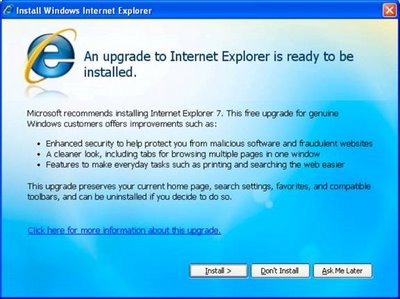
I suggest you print or copy the instructions below so you will know what to do before clicking the Install option when you are presented with the following:
http://www.microsoft.com/library/media/1033/technet/images/updatemanagement/windowsupdate/screen3_big.jpg

Preparation
When presented with the above image, IE7 will already be downloaded to the computer. Following are my recommendations before clicking "Install".

1. Disconnect from the Internet and save any work and close all open programs.

2. Disable your anti-virus software and close your firewall.

3. Create a restore point.
Before installing any software, it is wise to create a restore point. Creating a restore point is easy to do. Just follow these steps:
  • Click on the following: Start > All Programs > Accessories > System Tools > System Restore
  • On the next window that opens, select the option to "Create Restore Point"
  • Click Next. In the next window that opens, type in a description that you will remember.
  • Choose "Create" and then close System Restore.
4. Disable real-time protection
As recommended by Mr. Hrvatin, the next step is to disable real-time protection afforded by any anti-malware applications on your computer. The list is quite long so the main thing to remember is if during or after installation of IE7 you are prompted by the real-time protection software on your computer whether to allow or disallow the changes to the registry, it is important to allow the changes.
With most of the real-time protection applications accompanying anti-malware software programs, merely disabling the software is sufficient. However, for Lavasoft's Ad-Watch, additional steps may be necessary. As written in the Ad-Aware SE manual:
Even if Ad-Watch is turned off and something DOES install onto your system, it will recognize it and will kill the process as soon as it has seen it when turned back on.
Because of the variety of settings that can be selected for Ad-Watch, for this situation, I strongly suggest that anyone using Lavasoft's Ad-Watch take the extra precaution of disabling all blocking prior to the installation of IE7. After the installation is complete, re-enable the settings you had before. In the event you do not elect to take these steps, it is vital that you accept any changes that may be alerted by Ad-Watch.
To disable Ad-Watch:
  • Right-click on the Ad-Watch icon in the system tray
  • Select "Restore Ad-Watch"
  • At the bottom of the screen you will see 2 options -- Active and Automatic.
  • Uncheck both options (red X).
  • Under "Tools and Preferences" turn off all blocking actions:
Instructions for disabling other real-time protection is available in the Castle Cops Wiki. Follow the links below now for any of the listed software installed on your computer so you will know how to disable their real-time protection prior to installing IE7.
Install

Having followed the above safety precautions, the computer is now ready for installing IE7.


Clicking on the install button will start the process, which will require Windows Genuine Advantage validation. A restart will be necessary to complete the install.

Note that installation of Internet Explorer 7 will not override any default browser settings. In addition, all compatible toolbars, home/start page, favorites, and search settings will be transferred to IE7. When Internet Explorer 7 is launched, there will be a presentation offered that highlights new features and changes in IE7.

Addendum::

Microsoft MVP Harry Waldron installed IE7 after it was released in final. Here is what he discovered and posted in his blog:
"IE 7 - Recommended installation approach

* Use only the official download from Microsoft's site
* Reboot PC for fresh start (e.g., advanced users should take a system restore point)
* Shut down all started applications and Disable AV scanner
* Do not run anything else during the complete install process
* Wait patiently as some processes are long-running and might seem to hang, (overall this required about 5 to 10 minutes for me).
* Reboot as prompted (twice)
* Select the "run" to continue the process after 1st reboot.
* Keep lucky charms and a celebration kit handy, e.g., plenty of Mountain Dew "

Changes at Microsoft - One leads to Another


It started with this reorganization announcement, as reported at Microsoft Watch, by Peter Galli in "Microsoft Gets a New Security Group ",
"Microsoft is bringing its security, Trustworthy Computing and Engineering Excellence teams together in one group, known as the Trustworthy Computing Team."
That was yesterday. Today it was reported that Ben Fathi, who had replaced Mike Nash, will be heading up development of the core components of the Windows operating system. The security unit that he had been runnig will be absorbed into the new Trustworthy Computing Team, reported above. Scot Charney will head up the Trustworthy Computing Team. (See "Microsoft Security Czar Fathi to Focus on Windows OS" for the complete story.)

Follow that reorganization with this announcement about Windows Vista at c|net, "Microsoft changes Vista over antitrust concerns":
"Microsoft had planned to lock down its Vista kernel in 64-bit systems, but will now allow other security developers to have access to the kernel via an API extension, Smith said. Additionally, Microsoft will make it possible for security companies to disable certain parts of the Windows Security Center when a third-party security console is installed, the company said.
Security companies had complained that a kernel protection feature called PatchGuard in 64-bit versions of Vista not only locked out hackers but also prevented some security software from running."
The lock-down was one of the major security features we have been hearing about for some time. Particularly, after reading "McAfee and Symantec get vocal about Vista - but do they *really* have our best interests at heart" co-authored by Microsoft MVPs Sandi and Walter Clayton, I am concerned about what certainly appears on the surface as caving in. As Sandi wrote:
"The bad guys are getting past McAfee and Symantec and others, and if the “Big Two” were *truly* concerned with user security, they would not be fighting this change, which is going to make such a big difference in the malware fight by stopping the bad guys *before* they can do some of their most damaging and difficult to remove tricks. They’d be working on changing their code to work with what is going to be a quantum leap forward in security improvement for users.
Prevention is better than cure. Signature based scanning, heuristics and adding detection for new malware *after* it has already been released and has started infecting machines around the world, isn’t working. I need help to stop the bad guys from getting their tendrils so deep into the OS that it is getting more and more difficult to remove. It is getting to the stage where reformatting is sometimes the only option for systems infected with the worst malware, even with McAfee, Symantec or other security vendor's products installed, and that is simply not good enough."
Consider this quote in Sandi and Walter's article by Jesper Johansson:
"In a sense, [McAfee and Symantec] have built their business on protecting users of Windows from Microsoft, and Microsoft healing the patient cuts into their business doing the same. As Microsoft's Security Chief Ben Fathi said, the security vendors want Microsoft to "keep the patient sick," and by extension, keep customers at risk, so that the security vendors can keep charging for the healing."
But Ben Fathi is no longer Microsoft's Security Chief. Seems like the security vendors will continue charging for the healing.

Mozilla Firefox 2 Release Candidate 3 Available


It was announced at mozillaZine today that Mozilla Firefox 2 Release Candidate 3 (RC3) is available for download. It contains several bug fixes as well as security and stability updates.
If you used previous release candidates (RC1 or RC2) you can upgrade to RC3 using the software update feature.

Anyone who has not installed Firefox 2 is reminded that, although tagged "release candidate", this is not the final version. There may be additional bugs that need to be worked out. Please do not install on a production-critical machine and, of course, always create a System Restore Point prior to installing any software.

Microsoft Security Advisory 917021


Microsoft has released Security Advisory 917021 – Description of the Wi-Fi Protected Access 2 support for Wireless Group Policy in Windows XP Service Pack 2 - on 17 October 2006.

========================================
Summary
========================================

Microsoft is releasing this security advisory to inform customers about an update that enables Wi-Fi Protected Access 2 (WPA2) support for Wireless network Group Policy settings in Windows XP Service Pack 2. This update is being released to provide parity between Windows XP Service Pack 2 (before a broad release vehicle, like a service pack, is released) and the upcoming release of Windows Server 2003 Service Pack 2. With this update, customers can create Wireless network Group Policy settings to simultaneously manage WPA2 on systems running Windows XP Service Pack 2 and for any versions of Windows targeted by the upcoming Windows Server 2003 Service Pack 2.

Also included in this update are Wireless client behavior changes for non-broadcast and ad-hoc networks. These defense-in-depth changes are intended to help prevent systems from connecting to networks other than those a user intends to connect to.

The reason these defense-in-depth changes are included in this update in addition to the WPA2 support for Wireless network Group Policy is to provide parity between the two Windows versions. This makes it possible to manage WPA2 settings for wireless clients on different Windows versions using the same Wireless Group Policy.

These defense-in-depth changes will be included in Windows 2003 Service Pack 2 as part of the same WPA2 support for Wireless network Group Policy settings. For more information about the upcoming Windows 2003 Service Pack 2 see the Windows Service Pack Road Map: http://www.microsoft.com/windows/lifecycle/servicepacks.mspx. The broad release vehicle is still considered to be a service pack for Windows XP for the defense-in-depth changes included in update 917021.

========================================
Recommendations
========================================

Review Microsoft Security Advisory 917021 for an overview of the issue, details on affected components, suggested actions, frequently asked questions (FAQ) and links to additional resources.

========================================
Additional Resources
========================================

Drum Roll: Internet Explorer 7 Released!!!


The long-awaited date has arrived. Internet Explorer 7 has been released! As you have been advised, IE7 will be distributed via Windows Updates, starting in a few weeks.

See what is new in IE7 at the Microsoft Windows
Internet 7 website. Following is the announcement from the IE7 Blog by Dean Hachamovitch, General Manager, IE7 Team:
Internet Explorer 7 for Windows XP Available Now
Today we released Internet Explorer 7 for Windows XP. I encourage everyone to download the final version from http://www.microsoft.com/ie.
We listened carefully to feedback from many sources (including this blog) and worked hard to deliver a safer browser that makes everyday tasks easier. When I first posted publicly about IE7, I wrote that we would go further to defend users from phishing and malicious software. The Phishing Filter and the architectural work in IE7 around networking and ActiveX opt-in will help keep users more secure. IE7 also delivers a much easier browsing experience with features like tabbed browsing (especially with QuickTabs), shrink-to-fit printing, an easily customizable search box, and a new design that leaves more screen real estate for the web site you’re viewing. IE7’s CSS improvements are incredibly important for developers as many of you have made quite clear. I also think IE7’s RSS experience and platform are important, powerful, and innovative.
In addition to our release of IE7, Yahoo! has a customized version of the browser available today and over the next few days partners such as Weather.com and USA TODAY will offer their own customized versions. These versions will tailor the user experience with specific toolbars, additional search engines, favorites, and RSS feeds.
I want to thank everyone who provided feedback as we developed and fine-tuned Internet Explorer 7. Over the 20 months since Bill Gates first announced our commitment to deliver IE7, we released five betas and a release candidate to millions of users worldwide. With each release, your feedback helped us make IE7 better. Your contributions, ideas, and direct comments were crucial in helping us prioritize and focus our work. I can’t imagine delivering this product without the tremendous cooperation we enjoyed from so many of you as well as developers and partners.
That said, we’re not done. Even as we put the finishing touches on Windows Vista and release all the remaining language versions of IE7, we have already started work on the next versions of Internet Explorer. We’ll post more here soon about our plans for the product and our plans for listening to you.

Microsoft's View of "My Town"


This is a typical view of my area this time of year -- a view that is apparently appreciated by Microsoft. For the second time in a little over a year, Microsoft has selected a local company to partner in the Microsoft Windows Live program.

The first was Pictometry International Inc. for their development of a system for capturing and analyzing aerial digital images. That system is the basis of Windows Live Local (http://local.live.com).

The second, Kirtas Technologies, was announced locally yesterday:

"(October 18, 2006) — Technology giant Microsoft Corp. needed a partner for its massive digital books project and found it in a 5-year-old company in Victor.

Kirtas Technologies, which makes high-speed scanners for books and the software to edit and organize them, will be part of Microsoft's Live Book Search project. The digital books will become available early next year, Microsoft and Kirtas said Tuesday."
See the Democrat and Chronicle article for the full story.

IE7 -- "Bits from Bill" and Other Internet Explorer 7 News


There will be a lot of information available on the newly relased Internet Explorer 7 over the coming weeks. I will do my best to consolidate key information here in the Security Garden.
Included at the bottom of this posting are a number of references that you may find helpful.

  • WinPatrol Notes
Bill Pytlovany installed IE7 on his WinPatrol studio computers. For information on the changes you need be alerted to and information from the WinPatrol Plus database see "Bits from Bill: IE7 changes include IEFrame.dll". I suspect we will get further updates in "Bits from Bill".

  • IE 7 First Run Screen
Microsoft MVP Sandi Hardmeier documented what needs to be done if you experience problems with "The new Internet Explorer first run screen". Also keep an eye on Sandi's website, IE-Vista for help in learning about and using the new features in IE7.

  • First IE7 Advisory Issued and Refuted
Although not critical, Secunia issued Advisory 22477 described as follows:
"A vulnerability has been discovered in Internet Explorer, which can be exploited by malicious people to disclose potentially sensitive information.

The vulnerability is caused due to an error in the handling of redirections for URLs with the "mhtml:" URI handler. This can be exploited to access documents served from another web site.

Secunia has constructed a test, which is available at: Secunia

Secunia has confirmed the vulnerability on a fully patched system with Internet Explorer 7.0 and Microsoft Windows XP SP2. Other versions may also be affected."
Secunia's recommended work-around is to disable active scripting support. Microsoft Security Response Center has addressed this indicating:
"These reports are technically inaccurate: the issue concerned in these reports is not in Internet Explorer 7 (or any other version) at all. Rather, it is in a different Windows component, specifically a component in Outlook Express. While these reports use Internet Explorer as a vector the vulnerability itself is in Outlook Express."
  • IE7 Phishing Filter
One thing is certain, the IE7 phishing filter cannot come too soon. Note, however, that it is not turned on by default. (See IE-Vista Phishing Filter for instructions and information on how the Phishing Filter works.) The Register reported yesterday that a "Trojan download site spoofs IE7 release outlet":
"Hackers have created a bogus Internet Explorer 7 download site that attempts to load Trojan code onto the PCs of visiting surfers.

Traffic to the malicious website is being driven by a spoofed email message, claiming to be from support@microsoft.com, offering a link to download Release Candidate 1 (RC1) of Microsoft Internet Explorer 7."
  • Automatic Updates
As pointed out several times, Internet Explorer 7 will be delivered via Automatic Updates. However, it was with relief when reading reading Canuk's CyberNews4You update on Internet Explorer 7, that I followed a link to Tech Web and happily learned the following:
"The IE 7 update will also not add to the burden of Microsoft's monthly security patch delivery, scheduled for Nov. 14, promised Cobb. 'We won't do it on Patch Tuesday.'"
That in itself is a relief for the 40 percent or so of Americans who are still using a dial-up connection! However, that is not to say that IE7 may be delivered to your computer earlier. As we are reminded in the IE Blog,
"To help you become more secure and up-to-date, we will distribute IE7 via Automatic Updates as a high-priority update. We will start very soon with those of you who are already running IE7 pre-releases and then move onto IE6 users after a few weeks. We will progressively roll out to all IE6 users over a few months, so don’t be surprised if you don’t see the update right away."
  • IE7 Support
The other good news I learned from the Tech Web article is that Microsoft will be establishing toll-free telephone support for IE 7:
"Beginning Thursday, Microsoft will open a free, toll-free support line for IE 7. The help desk will be manned Monday through Friday 5 a.m. to 9 p.m. PDT, and on weekends from 6 a.m. to 3 p.m. PDT."
See Time and Date for converting PDT time to your local time zone.

Firefox 2.0 Released Early


I was checking the RSS subscriptions I have set up and certainly am glad that I did. Look what I found at the LangaBlog:
Langa Blog: Mozilla Secretly Posts Firefox 2.0 Early

Sure enough, Firefox 2.0 has been uploaded to the FTP server. You can get the Windows 32 version at this live link: http://ftp-mozilla.netscape.com/pub/mozilla.org/firefox/releases/2.0/win32/en-US/Firefox%20Setup%202.0.exe

Thursday, 26 December 2013

Microsoft | Dell Create Super-Cool Custom PC

I have been following Donna Buenaventura's adventures installing and experimenting with Vista on her Dell laptop (See Vista on Dell XPS M1210; Vista & Dell MediaDirect; Incompatible software). I think about now she may be sorry she has a laptop instead of a desktop like the one featured in the Windows Vista Blog today in Windows Vista Custom PC Design. That is most definitely a Windows PC!
When it comes to PC's for myself, I'm afraid that I have to stick to basics. I have a favorite local PC shop that I visit and pick out as much of a system as I can afford. I'm still using the 17" monitor I got with my old Win95 system and when the box was built for XP, they transferred the diskette drive and CD reader from the old box. It saved a few dollars. The nice part about using a local shop is in the event of a problem, they are close by and stand behind their work.

Firefox 2.0 and 3rd Party Cookies


One of the comments I've seen about Mozilla Firefox 2.0 is the removal of the option to block 3rd party cookies. Firefox people have explained that the reason that feature was removed is because it was not reliable and did not work in all configurations.
Now, before you get all hot under the collar about the cookie issue, I suggest you visit, or revisit in the case you have already read Ben Edelman's analysis, sponsored by Clicks2Customers, in "Cookies Detected by Anti-Spyware Programs: The Current Status".
However, if you still want to make a change to Firefox, and we are talking about 3rd party cookies anyway, it can be easily made in Firefox about:config.
  • Open a Firefox browser tab
  • Type about:config in the address bar
  • Scroll down the page to network.cookie.cookieBehavior
  • If the value is 0 (zero), right click on that line and change the 0 to the number 1 (if it is already a 1, that means the configuration was carried over in the upgrade to 2.0).

Vista Yields Almost Double the Drivers of XP!


As a take-off on the old 1980's gum commercial, it looks like Windows Vista will "Double your drivers, double your fun".

When I read
Langa Blog: Vista to Ship with Nearly 20,000 Device Drivers, I had to check the RCP Mag myself. Sure enough, the article indicates that Vista will ship with 19,500 device drivers.
According to Jim Allchin, however, this may not be all bad. Hopefully, when installing Vista, users will find that the drivers needed to run their software are already on board. Here's what was reported:

"The number of device drivers is really a small way of looking at it, since each driver can usually support numerous actual different device models. Indeed, sometimes a single driver can support hundreds of different models, as often is the case with video drivers," Allchin's posting said. "But, what is even more significant is that at the RTM [release to manufacturing] for Windows Vista, we already had an additional 11,700 device drivers on Windows Update compared to just 2,000 for Windows XP when it RTM'd in 2001."
Having read reports of Vista installations, it appears that this really has been paying off. I think its just the shock of the large number that sounds so unrealistic.

Once Again: Microsoft | Novell | Patents

Ok, Microsoft, its time for some new news out of Redmond. This harping on the Microsoft | Novell agreement is beginning to seem like there is nothing else happening in the world of computers.
One of my favorite bloggers, Mary Jo Foley, is still waiting to hear details from Microsoft. In This Microsoft-Novell partnership's not all it's cracked up to be, she wrote:
"At least Microsoft is admitting "Novell is absolutely right in stating that it did not admit or acknowledge any patent problems as part of entering into the patent collaboration agreement." When I asked Novell this very question, Novell officials did, indeed, publicly claim they were not admitting any infringement."
This is "patent-lawyer-speak" and has "always" been the way they handle such issues. I am speculating that Microsoft attorneys presented Novell with a list of patents that Microsoft, in Microsoft's estimation, Novell was infringing. Novell attorneys examined the patent claims and compared them to the product(s) in question.
To begin with, patent infringement litigation is extremely expensive and can run into the hundreds of thousands of dollars very quickly.
  • Producing the voluminous reams of documentation is both time-consuming and costly. Inventor records, computer hard drives, paper files all need to be gathered, copied and provided to the court and the opposing counsel.

  • Outside counsel is generally consulted for an independent evaluation. They charge hundreds of dollars per hour plus expenses.

  • This is without considering internal attorney and other staff time.

Is it warranted? If counsel evaluation determines that they do not believe there is patent infringement, it is likely worth the court battle. However, if there are any gray areas -- areas where particular claims are significantly broad that they could possibly be interpreted as covering the products in question, it would be in the best interests to negotiate a settlement.
Thus, the statements are correct. Novell is not admitting patent infringement as patent infringement can rightfully only be determined by a court of law. Finally, there is no infringement when there is a license to make, use or sell.

Microsoft Office 2007 UI Licensing "Open Source"


With all the recent talk about patents, infringement and licensing, some of the critics should step back and take a look at the licensing terms for Microsoft Office 2007. The guidelines are incorporated in a mere 120 page (gulp) document. However, there is a preview available for download as well as video on Chanel 9. Both links are available in Jensen Harris' blog writeup, "Licensing the 2007 Microsoft Office User Interface"

The long and the short of it, however, is that developers can use the Office 2007 UI (user interface) in open source projects as long as they meet the license terms. Not only that, the UI can be used on any platform.

As stated by Jensen Harris in "Licensing the 2007 Microsoft Office User Interface"
"There's only one limitation: if you are building a program which directly competes with Word, Excel, PowerPoint, Outlook, or Access (the Microsoft applications with the new UI), you can't obtain the royalty-free license."
Considering the high cost of development, I think this is both very fair and generous of Microsoft.

Firefox 2.0 Password Manager Bug Exposes Passwords


This is a serious bug if you use the Firefox Password Manager. As described at Slashdot.org:

"The flaw derives from Firefox's willingness to supply the username and password stored on one page on a domain to another page on a domain. For example, username/password input tags on a Myspace user's site will be unhelpfully propagated with the visitor's Myspace.com credentials."
Using Control + Shift + Delete will clear private data in Firefox. In addition, turn off the Password Manager and the Firefox extension "Master Password Timeout" if you use it.